Accessibility isn’t a test: Why inclusive exercise benefits everyone

Ella Beaumont, Founder of EllaBeePT, shares her advice on how to make your group exercise classes more accessible to all.
Accessibility is fundamentally good teaching. Offering different ways to participate, explaining movements clearly, avoiding assumptions and creating an environment where people feel comfortable communicating their needs will benefit many participants, not only people who identify as disabled. Disabled people don’t only want to attend classes labelled as disability or specialist exercise.
People may also have temporary injuries, fluctuating conditions, sensory differences or access needs that aren’t immediately visible. And everyone’s own access requirements can change throughout our lives.
“You don’t have to be a specialist disability instructor before you’re allowed to be inclusive, because inclusivity is actually meeting everybody’s needs, not just people with a disability.”
There is definitely more awareness and visibility than there ever used to be. We’re seeing more disabled instructors and participants represented, more conversations about inclusive coaching, and greater recognition that accessibility isn’t simply a niche or specialist subject.
There is also much more discussion around adaptations and giving participants options rather than expecting everybody to perform an identical movement.
Where we still have work to do is move from representation and good intentions to consistent access in practice.
Are there any styles of classes that suit accessible teaching better than others?
Some formats naturally make adaptation easier. For example, classes where participants can work at their own pace or where movements aren’t dependent on everybody doing exactly the same thing at exactly the same time.
But I would be cautious about saying that particular types of exercise are inherently “accessible” or “inaccessible”.
The instructor’s approach can matter just as much as the format. A traditionally adaptable class can still be inaccessible if the environment or teaching style creates barriers, while a seemingly difficult format can become much more accessible through creative programming and communication.
It comes back to asking: What is the intention of this exercise, and how many different ways can somebody achieve it?
Is there any language instructors should use or avoid?
I wouldn’t want instructors to become so frightened of saying the wrong thing that they stop communicating with a disabled participant or client altogether.
Generally, use the language the person uses about themselves. “Disabled person” is widely used and preferred by many people in the UK, while others prefer “person with a disability”. Individual preference matters.
I’d avoid language that implies tragedy or limitation unnecessarily—things such as “wheelchair-bound”, “suffers from” or praising someone as “inspirational” simply for participating.
The bigger mistake, though, is often assumption rather than terminology: assuming somebody can’t do something, assuming they need help, or conversely assuming that an adaptation you’ve learned will work for every person with that disability.
Ask rather than assume.
And if you use the wrong word? Listen, apologise, if necessary, adjust and carry on. Inclusivity shouldn’t become so anxiety-inducing that nobody talks to anybody.
How can instructors build accessibility into the customer journey for their participants?
Ideally, accessibility would be built into the process before the participant has to ask for it.
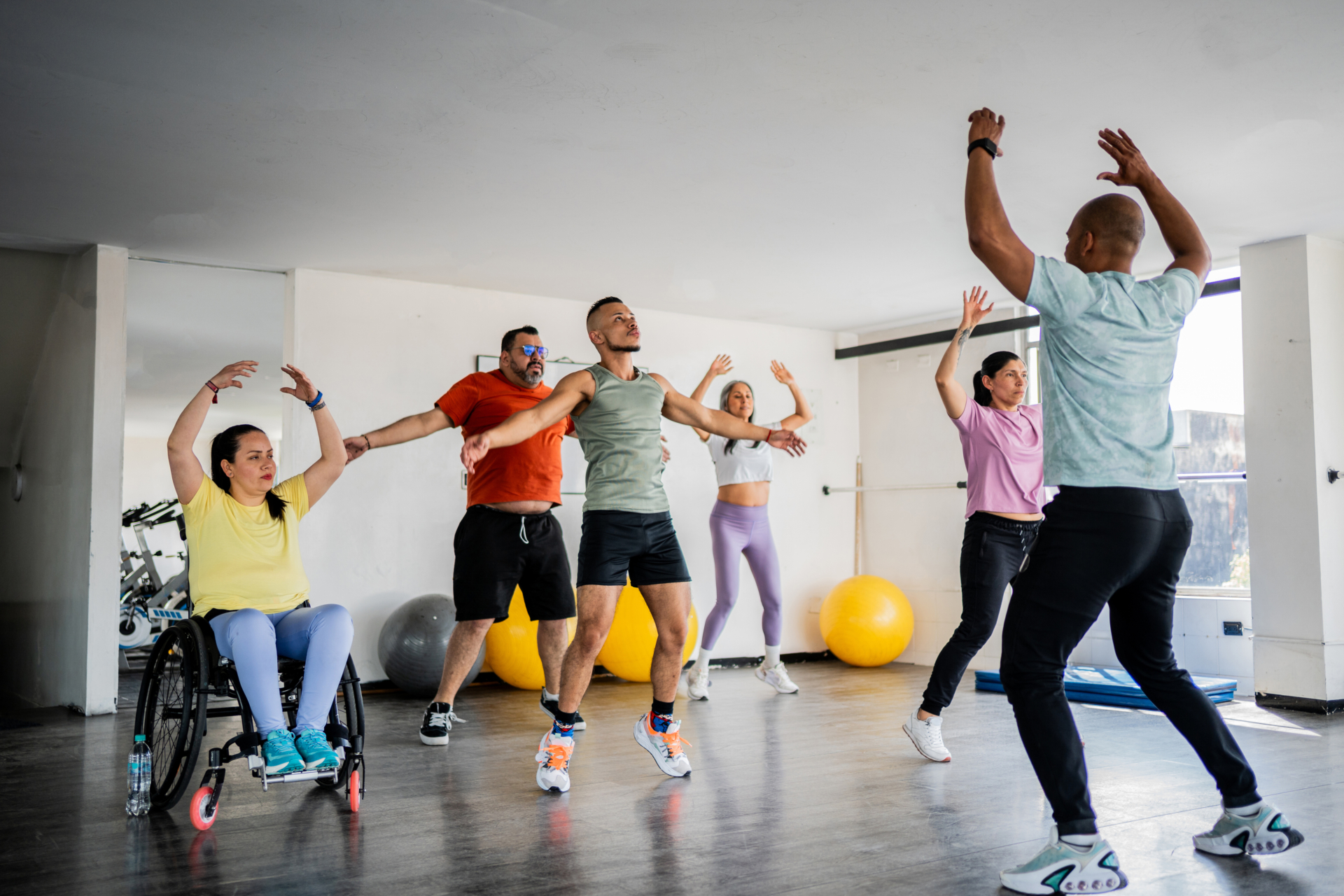
A promotional photograph of a wheelchair user doesn’t make a class accessible if they can’t get through the building. Calling something “inclusive” doesn’t tell someone whether there’s an accessible toilet. And training an instructor to offer seated movements doesn’t solve an inaccessible booking process.
When the opportunity is advertised or offered, there should already be useful access information about the venue and teaching environment. During onboarding, there should be a straightforward opportunity to communicate access requirements without the instructor having to disclose unnecessary personal or medical information.
Before their first class, a participant should know practical things such as:
- where to enter,
- where to park if relevant,
- whether access is step-free,
- what doors/lifts are involved,
- where the studio and toilets are,
- what equipment is available and
- who to contact if there’s a problem.
Any agreed adjustments should be communicated to the people who need to implement them. The instructor shouldn’t arrive and discover that reception knows nothing about the arrangement they’ve spent weeks organising.
And then, crucially, accessibility shouldn’t be treated as a one-off onboarding exercise. There should be an easy way to say, “Something has changed,” or “This isn’t working,” and have it addressed and adapt accordingly.
The ideal experience is actually quite unremarkable: the instructor gets the information and adjustments they need, arrives, gets into the space, teaches their class and goes home—without accessibility becoming an additional job they have to perform.
Finally, remember: “It’s not as intimidating as it seems”: accessibility isn’t about having a perfect answer for every possible person. It’s about creating an environment where people can tell you what they need, believing them when they do, and being willing to adapt.
Many instructors worry about getting it wrong. What would you say to them?
Don’t panic, you probably will get something wrong at some point—this is only natural and that’s okay as long as you’re willing to listen and learn from it.
You don’t need to arrive knowing every possible adaptation for every possible disability. Nobody does.
What matters is being approachable enough that a participant can say, “That doesn’t work for me,” without feeling awkward, and flexible enough to respond with, “Okay, let’s find something that does. “Accessible exercise is all about trial and error, and that’s okay.
An instructor who is curious, respectful and willing to collaborate is often much more successful than somebody who has memorised 100 “disabled adaptations” but never actually asks the person in front of them.
Accessibility is a practice, not a test you pass.