
Last Updated on March 20, 2026 by Laura Jensen
We often act like we need to invent something new to solve the UK’s growing health challenges.
But what if the solution is already in our communities – running every day in halls, leisure centres, church rooms and school gyms?
We often act like we need to invent something new to solve the UK’s growing health challenges.
But what if the solution is already in our communities—running every day in halls, leisure centres, church rooms and school gyms?
It’s simple. It’s powerful. And it has the potential to transform prevention at a population scale: group exercise.
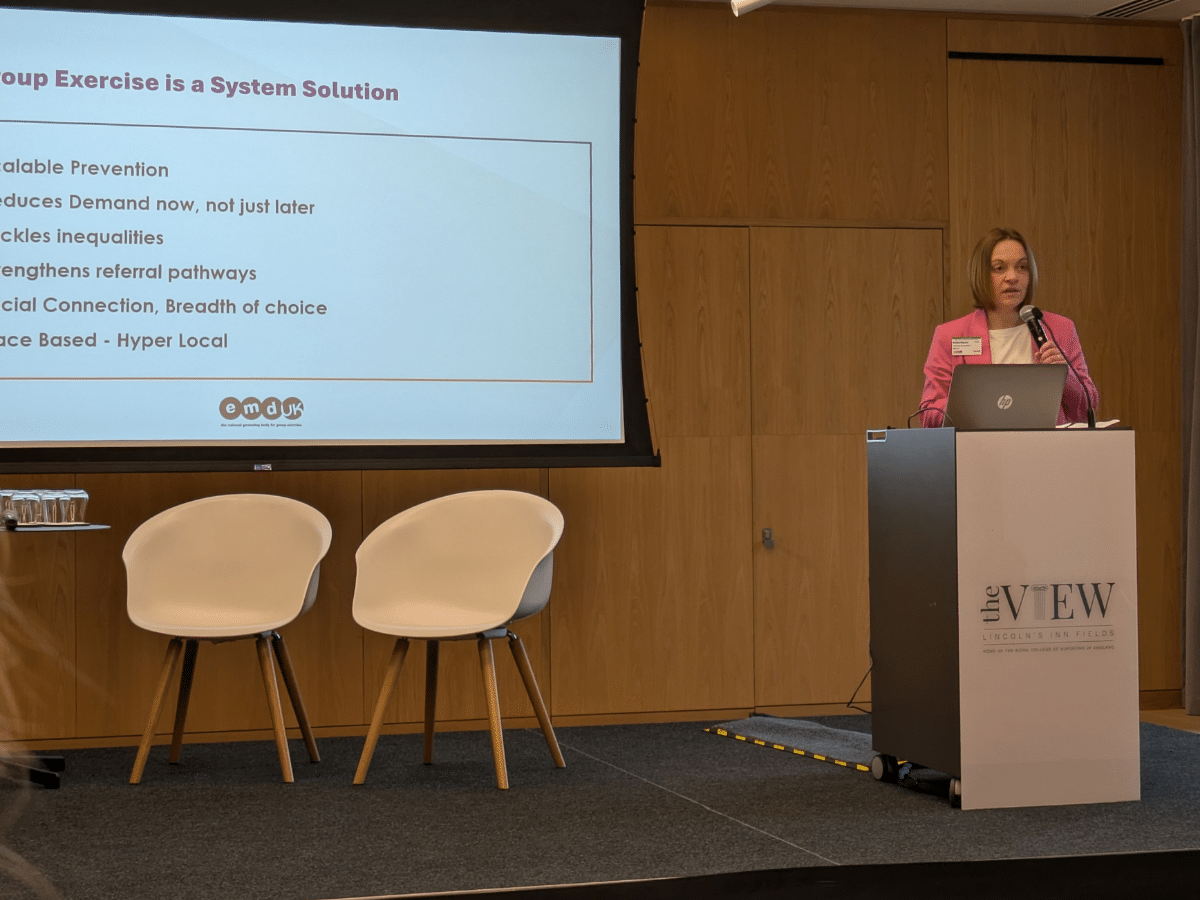
This was the central message from EMD UK’s COO, Shelley Meyern, at the Why Sports 2026 Conference – an argument not for new ideas, but for better use of what already exists.
What is the problem needing to be addressed?
Before we look at the solution, we need to be clear on the reality we’re working in. One in three adults’ lives with a long-term condition, something that affects their quality of life and their abilities on a daily basis.
We also know that physical activity is one of the most effective interventions we have – thanks to the EMD UK Social Value Report – and yet uptake remains stubbornly low.
The Chief Medical Officer said it best: “If physical activity were a drug, we would call it a miracle cure.” And yet people aren’t accessing this ‘miracle cure’ at scale.
We often act like we need to invent something new. But what if the solution is already in our communities – in our halls, leisure centres, church rooms, school gyms?
We don’t have an innovation problem. We have an implementation problem.
So instead of asking: “What new solution do we need?” We need to ask: “How do we scale the solutions we already have?”
So, why group exercise specifically?
Yes, we are biased, but group exercise works because it gives people what they need to make change:
- Physical and mental wellbeing
These sessions improve strength, mobility, mood, confidence and reduce loneliness. Stronger bodies, improved mobility, better sleep. And this isn’t anecdotal – our own Social Value Report shows that group exercise participants consistently report improvements across physical function, confidence, and emotional wellbeing. - Motivation and adherence
Group exercise provides structure and accountability. You don’t just turn up for the class – you turn up for the people. This is why group exercise has such strong adherence. - Inclusivity and adaptability
From Pilates to chair based movement, to dance, circuits, strength, yoga -there is something for every age, every ability, every condition. - Public health impact
It aligns perfectly with NHS priorities: prevention, reducing inequalities, community-based support and improving mental wellbeing.
And importantly – it’s already there.
Over 65,000 instructors delivering sessions in every type of community setting, you can imagine.
This is a workforce already serving the people who need prevention most. Group exercise isn’t something we need to invent. It’s something we need to integrate.
And crucially – our Social Impact Report shows measurable positive impact on the health system itself. Participants reported fewer GP visits, increased ability to self manage long-term conditions, and reduced reliance on medication.
Examples of group exercise in action
A study titled ‘Cycling against hip pain’ (CHAIN) [1] conducted by Bournemouth University and University Hospitals Dorset NHS Foundation Trust found that 30 minutes of group indoor cycling, coupled with a 30-minute education session with a physio was more effective at treating hip pain, particularly hip osteo-arthritis, than regular physiotherapy.
The CHAIN programme combined static cycling with education sessions to help manage symptoms of arthritis and joint pain. The study’s findings suggest that indoor cycling can be an effective and low-cost intervention for hip osteo-arthritis, potentially saving the NHS millions and reducing waiting lists for surgery.
In addition to this, in their case study, Josefa Domingos (2022) [2] found that group exercise programmes for Parkinson’s disease patients significantly improved motor functions, balance, gait, and overall physical activity levels.
This is demonstrable ways of how this works when we come together.
What challenges are we facing?
We also need to be honest about the system we’re working within.
Our health services are under extreme pressure:
- Rising long-term conditions
- An ageing population
- Demand that outstrips capacity
- Lack of a joined-up approach
- Inequalities that persist and deepen
Too much of our spend goes on treating illness, not preventing it. We know inactivity drives conditions – but prevention is still not operationalised at scale.
And then there’s the perceived issue of trust. Some think that trust between the health sector and the physical activity sector isn’t where it needs to be – is this really the case?
As a sector we have:
- a developing workforce governance register,
- stronger qualification standards,
- credible, specialist training pathways,
- safeguarding and professional development frameworks.
We’re ready to partner. We just need the system to see us as the prevention workforce we already are.
Why is group exercise a system solution?
Here’s the opportunity: group exercise is not just beneficial… It is a system-level solution.
- Scalable prevention
It delivers the two ingredients behaviour change absolutely requires: structure & social accountability. Group exercise delivers both consistently, affordably, and at scale.
- Reduces demand now
Not in five years. Not after another pilot. Now.
People who are active experience better mental health, less pain, greater independence, fewer GP visits, reduced reliance on medication and better outcomes.
We know group exercise and physical activity doesn’t fix everything! But the enhanced recovery programme shows where this does work. Keep reading to find out more about this specific factor.
- Tackles inequalities
It reaches people traditional health services often struggle to connect with because it is hyper-local, culturally adaptable, trusted, affordable, and often female-led or peer-led.
- Strengthens referral pathways
We all know the gap: Too many people fall between “not clinical enough” and “not confident enough to be active alone”. Group exercise fills that missing middle.
Imagine if every clinician could refer people into ready-made, quality-assured, evidence-based programmes in their community today.
- Social connection, breadth of choice
We know that telling someone to be active isn’t enough. Helping them understand why and providing supportive environments – that’s where change happens.
Group exercise is often commented on for the social connections it fosters, and, with such a breadth of activity, choice is likely to resonate better than some other activities.
Imagine a system where every GP, every link worker, every social prescriber has immediate access to quality-assured group exercise options – available within a mile or two of the patients. Where they can meet like-minded people and find a supportive community.
That’s the opportunity in front of us.
What data and proof of impact do we have to back this up?
This isn’t hypothetical: the data is already compelling.
- 10.6 million adults use group exercise as part of their activity blend.
- More adults choose group exercise than swimming, cycling, or football.
- Over 4 million people from lower-activity or disadvantaged groups take part.
- Group exercise creates £5.3 billion in social value every year.
- And an additional £511 million in secondary value.
This is prevention at scale and it exists already. We just need to integrate it into the system.
You can read more about this in our downloadable report The Social Value of Group Exercise.
So, what’s next?
We want to work with Health Champions, Integrated Care Systems and Integrated Care Boards, NHS teams, Active Partnerships, GPs, link workers, charities to align group exercise fully with health priorities.
But before we tell you what we think we could do… we want to hear what you need from us.
We could set about developing tools and resources, things like:
- Evidence briefings for healthcare professionals
- CPD modules for link workers and GPs
- Integrated referral pathways
- Visibility on platforms used within the healthcare system
- A national network of Movement Mentors and specialist instructors
But this only works if we build it together.
To demonstrate the tangible value of group exercise, we invited Pauline Cockburn, a KFA instructor, to share her story. For her, community group exercise wasn’t just activity, it was a lifeline.
You can read about her experience with group exercise by clicking the link below.
Conclusion
All we need is partnership. So, let’s talk, let’s collaborate, and let’s build a healthier, more active nation – together.
Together, we can make group exercise the default choice for health and wellbeing. We have the workforce, we have the evidence and we have the reach.
We can scale prevention right now. And this prevention comes with the potential to reduce demand, improve lives, and tackle inequalities. All we need are the partnerships and pathways to connect the system to what already exists.
[1] https://www.bournemouth.ac.uk/research/projects/cycling-against-hip-pain
[2] https://books.radbouduniversitypress.nl/index.php/rup/catalog/book/practicalities-of-communitybased
